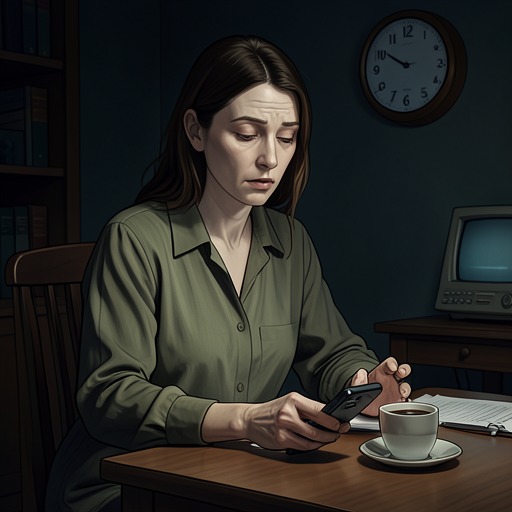
Laura Blacklock's anxiety disorder
The Woman in Cabin 10Laura Blacklock’s anxiety disorder is both a private, recurring struggle and a vulnerability that others misread. Panic attacks begin in her teens, talking therapies offer only partial help, and medication becomes central to her ability to function. During the crisis aboard the Aurora, a prolonged gap in her doses makes an already terrifying confinement harder to endure; outside the ship, strangers use her medication to cast doubt on her character and presumed fate.
Identity and Early Pattern
Laura dates her first panic attack to around the age of thirteen or fourteen. It arrives and passes, leaving her frightened, but she tells nobody: she assumes that being unable to breathe and shaking must mark her as strange when everyone else appears to move through life without such episodes. The secrecy is part of the condition’s early burden. Her distress is real, but shame keeps it from becoming something she can explain or seek help for openly.
The attacks return around the time she is taking her A levels. At first they are occasional; then they become frequent enough that managing anxiety feels like a full-time occupation and the world seems to close in. Laura does not connect this history to an abusive or deprived childhood. She remembers loving, supportive parents and says there was no violence or exceptional pressure to achieve. That absence of an obvious cause does not make the symptoms less serious. She describes her experience as more complicated than a simple story about insecurity or personal weakness.
Treatment and Medication
Laura tries several forms of therapy. A therapist chosen by her mother searches for a hidden secret that might explain the attacks, but Laura has no such revelation to offer. A community support group exposes her to young women dealing with problems including anorexia and self-harm. Later, a cognitive behavioral therapist teaches her breathing and counting techniques. These approaches help to some degree, but none resolves the problem for her.
Medication proves more effective. Laura describes the depression that followed university as something she experienced as chemical and not readily fixed by talking therapies. She compares medication to makeup: not a disguise, but a way of feeling more like herself and less raw. The comparison expresses her objection to treating medication as an alteration of her authentic identity. For her, it enables a more livable version of that identity.
An attempt to stop the medication shows the cost of assuming that improvement means recovery. With her GP’s guidance, the dose is reduced from forty milligrams to twenty, then ten, and finally ten every other day before she stops. She manages for two months, then loses thirty pounds and risks losing her job at Velocity; her colleagues do not know why she has stopped coming into the office. Her friend Lissie alerts her mother, who takes her back to the GP. The doctor considers withdrawal a possible explanation, restores the original forty-milligram dose, and Laura feels better within days. A future attempt to stop is left for another time.
Disruption Aboard the Aurora
That earlier history makes the missed medication during the voyage consequential. After an argument with Ben Howard, Laura goes to the spa without taking her pills; the subsequent shower episode further interrupts her routine. She realizes that at least forty-eight hours, and perhaps closer to sixty, have passed since her last dose. The realization frightens her. She is not simply in a confined space: she is trapped in a steel enclosure six feet below sea level, with no easy way to restore the routine that has helped her cope.
The novel distinguishes this acute fear from evidence that Laura is unreliable. Her anxiety can intensify her distress, but the fact that she is frightened or medicated does not establish that her account of events is false. In conversation with Carrie, Laura argues that Richard Bullmer’s success in securing Anne’s money would leave him with reason to protect himself. When Carrie resists the warning, Laura presses her to consider the danger rather than accept Richard’s assurances. Later, Laura appeals to Carrie to let her go, saying she would not be believed if she reported another apparent death at sea. Her fear of disbelief is tied to the treatment of her earlier report, not proof that the report was imagined.
Public Speculation and Credibility
The Whodunnit detective forum turns Laura’s treatment into a public theory about her disappearance. An anonymous poster claims she has serious problems, calls her unstable, and suggests that the police may be considering suicide. Other users speculate about Judah Lewis and whether he could have reached Norway. Judah responds that Laura takes medication for anxiety, not depression, and rejects the implication that medication makes her unstable or suicidal. He also explains that the recovered body has not been identified as Laura and that the case remains a missing-person investigation. The forum’s administrators close the discussion after the exchange grows unpleasant.
The later confusion over the body reinforces how quickly uncertainty becomes a story about Laura. Scotland Yard asks Judah to identify photographs of clothing recovered in connection with the case; he recognizes Laura’s distinctive vintage boots, and her family fears the clothing means she is dead. A later news report clarifies that the body was never identified as Laura and that she was found alive in Norway. The report acknowledges poor communication between the British and Norwegian forces, while noting that Norwegian police do not consider Laura a suspect in either death. These developments separate the evidence about her whereabouts from the online assumption that her medication explains her disappearance.
Narrative Significance
Laura’s anxiety shapes the conditions under which she experiences danger, but the narrative refuses to make it a shortcut to a diagnosis of untrustworthiness. Her own account links the condition to panic, disrupted functioning, and the practical value of medication; Judah’s correction distinguishes anxiety treatment from the forum’s claims about depression and suicide. The contrast exposes how readily observers turn psychiatric treatment into a moral judgment, especially when facts are incomplete.
The condition also gives the shipboard confinement a specific psychological pressure: Laura knows that her medication routine has been interrupted while she is isolated below sea level. Yet her fear coexists with attention, inference, and attempts to persuade Carrie. Anxiety is neither a cure-all explanation for her actions nor a reason to dismiss her testimony. Its importance lies in the tension between Laura’s lived experience and other people’s use of that experience to decide, without evidence, what kind of person she is and what must have happened to her.